Recognizing My Child's Face Growing Up Adopted
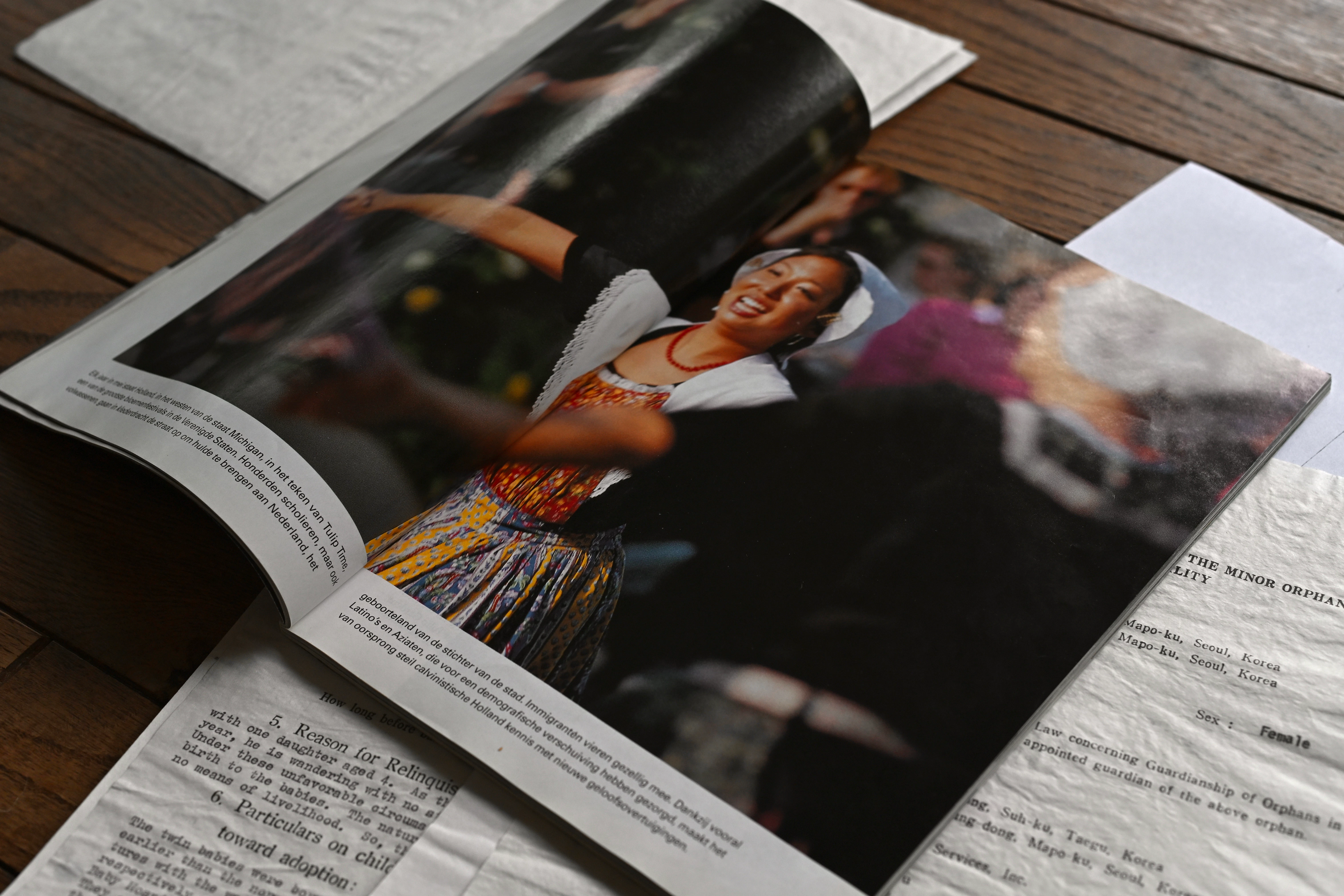
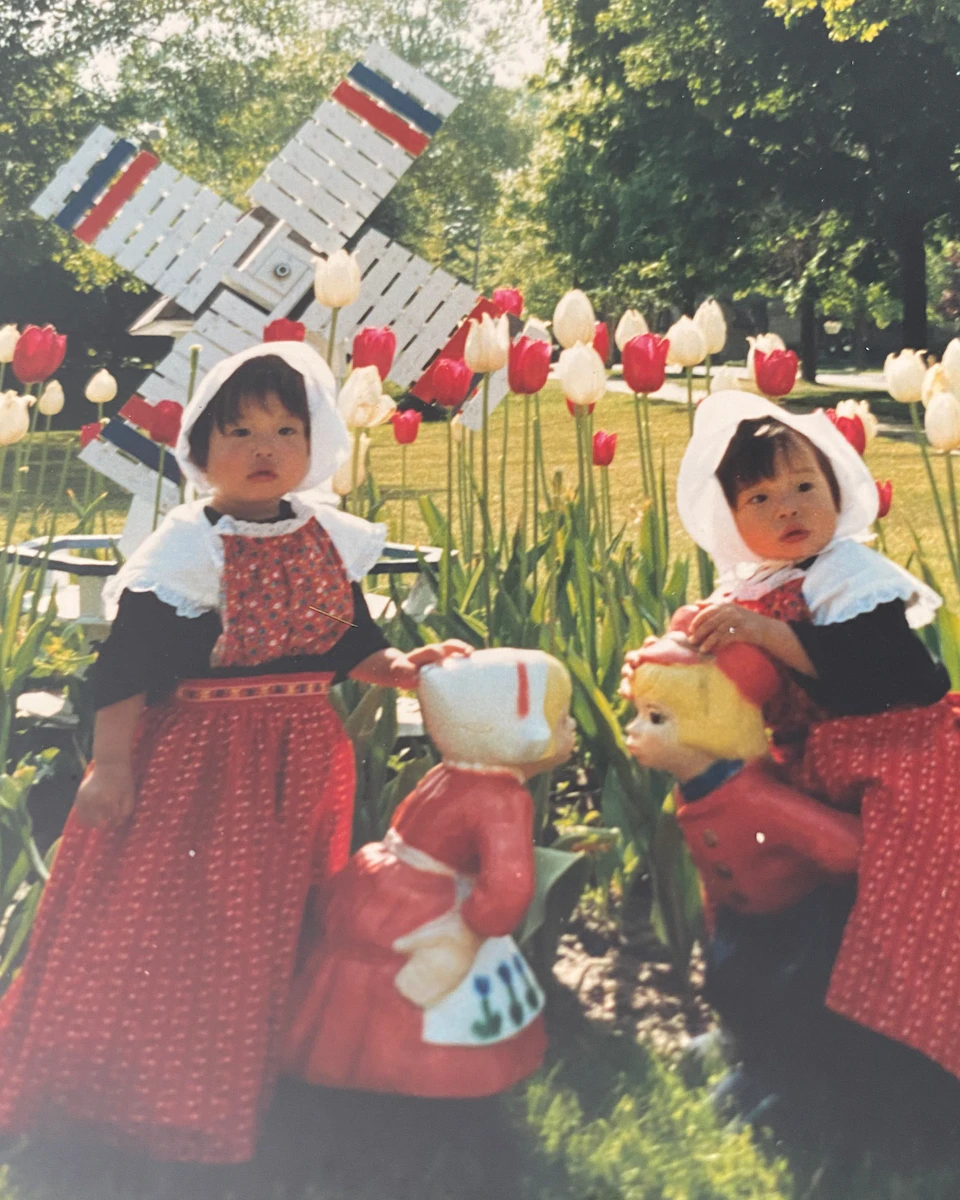
When I was 17, I graced a two-page spread in National Geographic. Before you start picturing me in various levels of undress, let me assure you, it was not nearly that interesting. I was, in fact, aggressively clothed: three nearly floor-length skirts, five pairs of men’s dress socks, a headpiece, and wooden shoes.
What’s striking isn’t that the photographer caught my face at the most unflattering angle known to man (read: infinite chins), or that I was glistening in the unseasonably warm 85-degree weather that spring afternoon. It wasn’t even that I was wearing a replica of an 1800s Dutch outfit while kicking my legs nearly to my nose in wooden shoes.
Rather, what made this photo worthy of National Geographic was that at a festival celebrating Dutch heritage, there was a short Asian girl dancing her heart out—a decided contrast in a sea of tall, willowy Dutch girls.
The photo’s caption says it all: “Students of all ethnicities and cultures participate in Tulip Time.”
"I don't remember ever being proud of being Asian. Not once. Being Asian felt like my scarlet letter."

Summer 1985, Seoul, South Korea — Seoul was swelling toward modernity as it prepared to host the 1988 Olympics, but some creature comforts still lagged behind. Central air conditioning was rare well into the nineties. In the thick humidity of Korean summers, subways, apartment buildings, and even hospitals relied on electric fans and open windows to stir the heavy air.
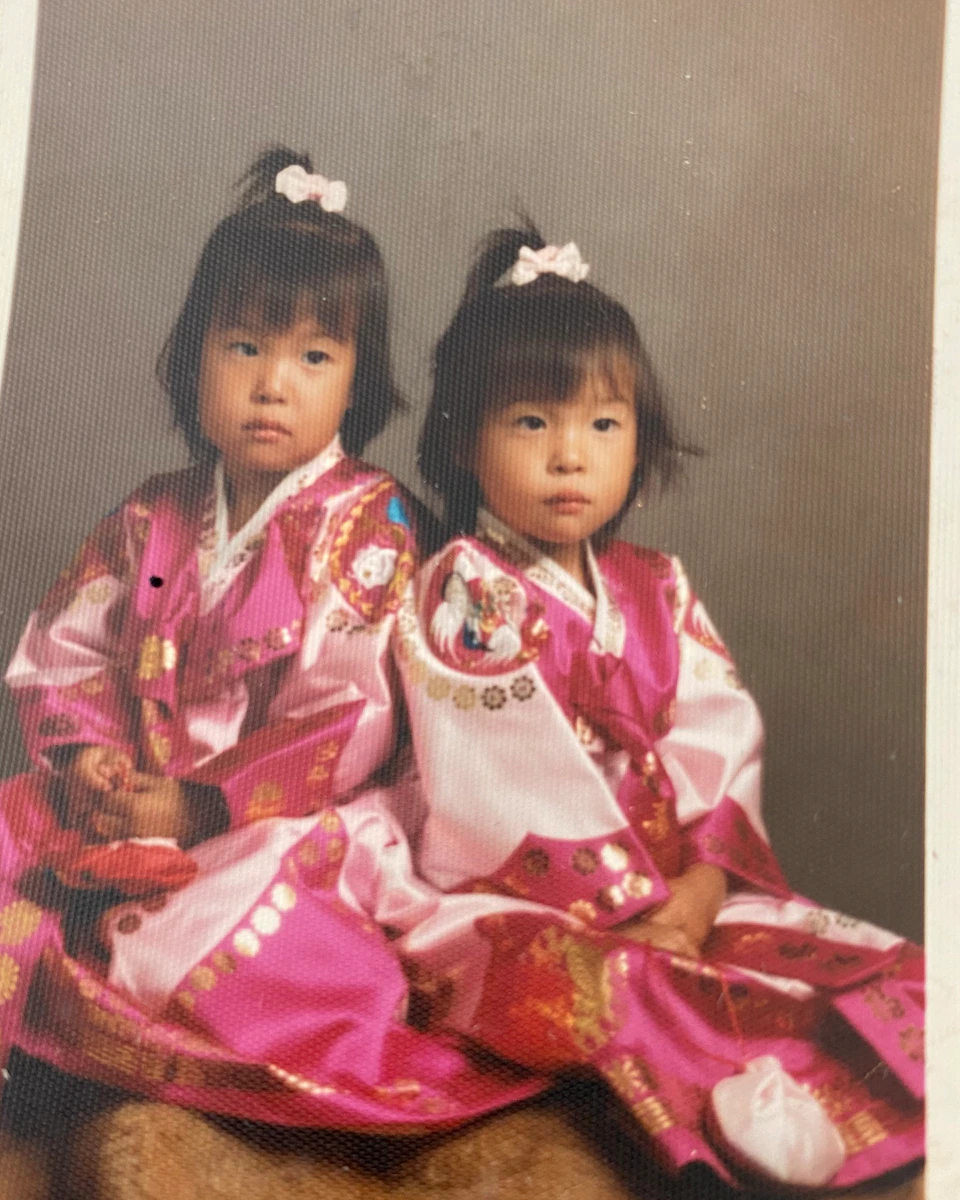
I was born on the first day of July, at the peak of monsoon season. My twin sister arrived shortly after me, just before dinnertime.
We were three weeks premature and tiny. I weighed four pounds; my sister weighed only two. The NICU became our home for the next several months—sleeping in incubators, learning how to take bottles, growing stronger under fluorescent lights and the churn of electric fans.
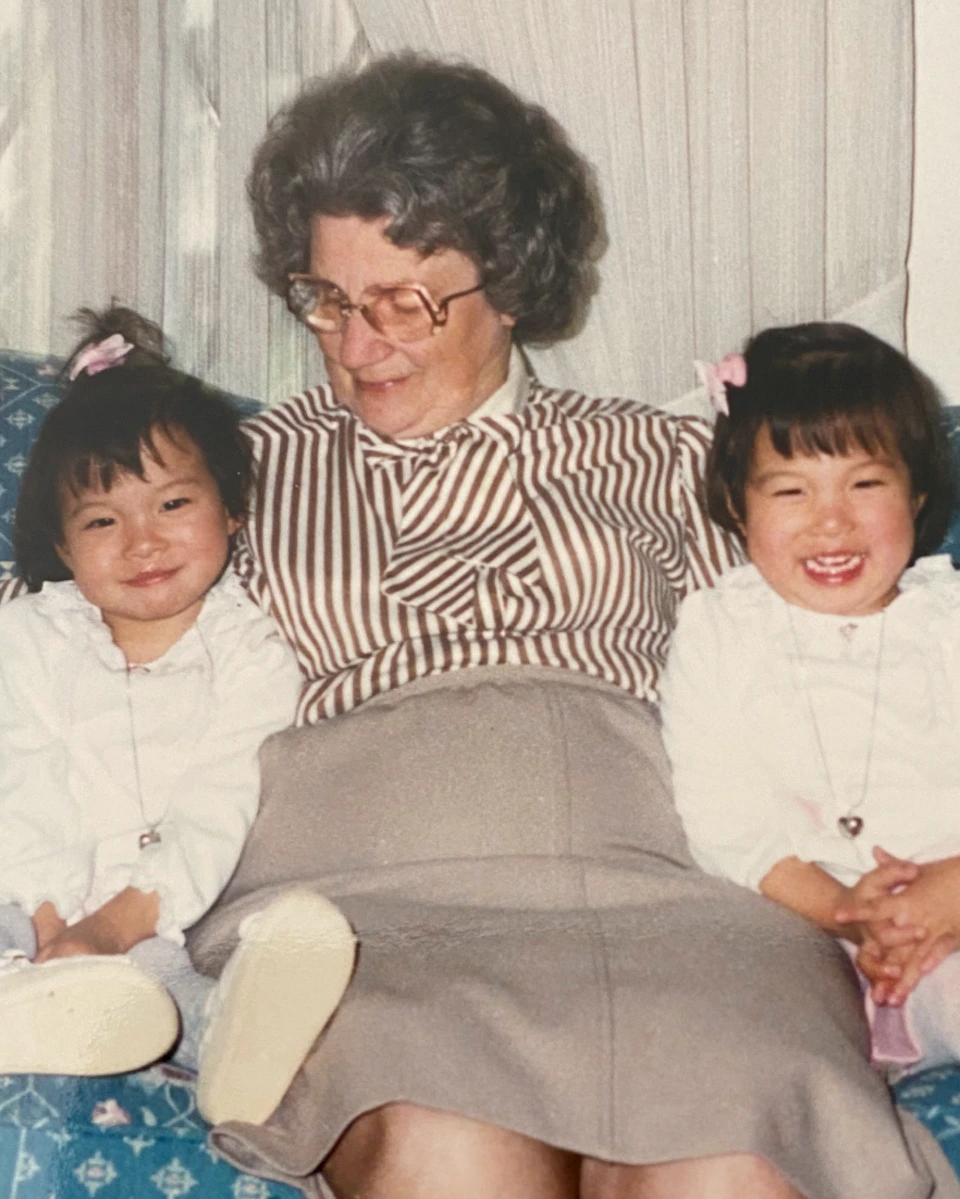
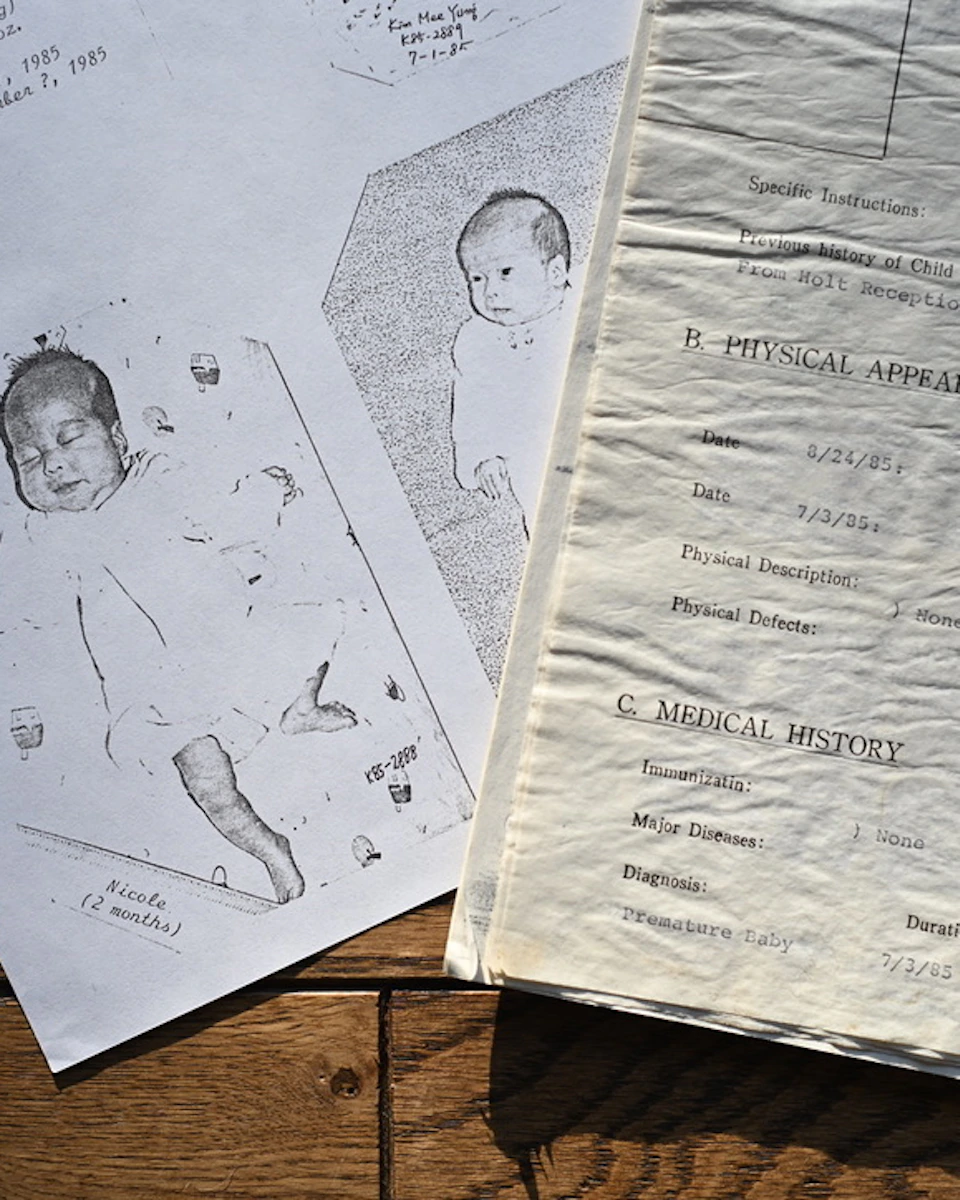
My adoption papers describe me and my sister: “Mee Sun is a pretty baby girl with double eyelids and a high nose. She and Mee Yung are scheduled to be adopted into a good home which wants babies keenly after leaving the hospital.”
Did the air feel heavy and close—the heat cloaking you like a blanket? Contractions for two, on top of the heat—did you ask for water, for ice chips? I imagine you silent and stoic.
Were you wishing for the pain to end? Or did you welcome it, knowing our arrival into the world was also our departure from you.
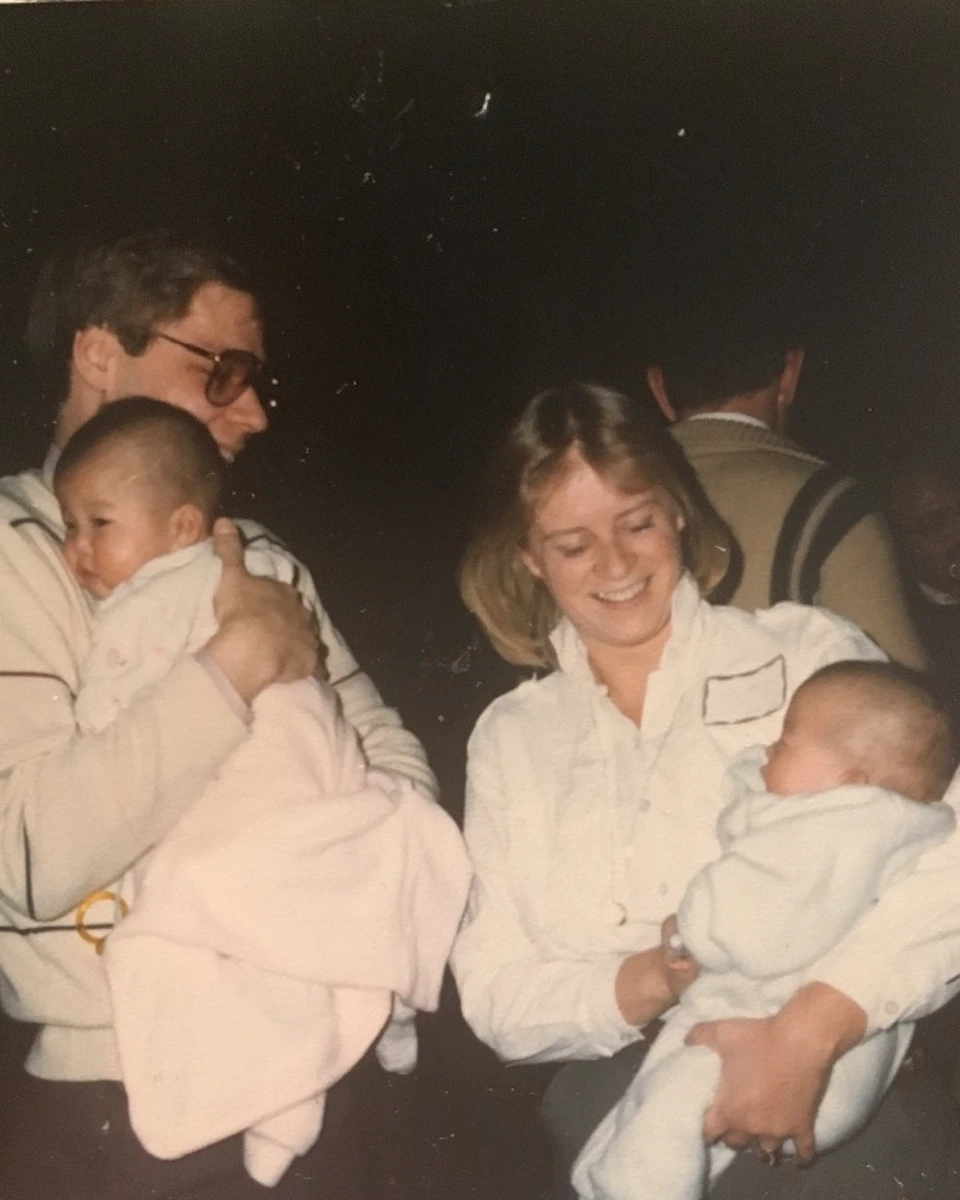
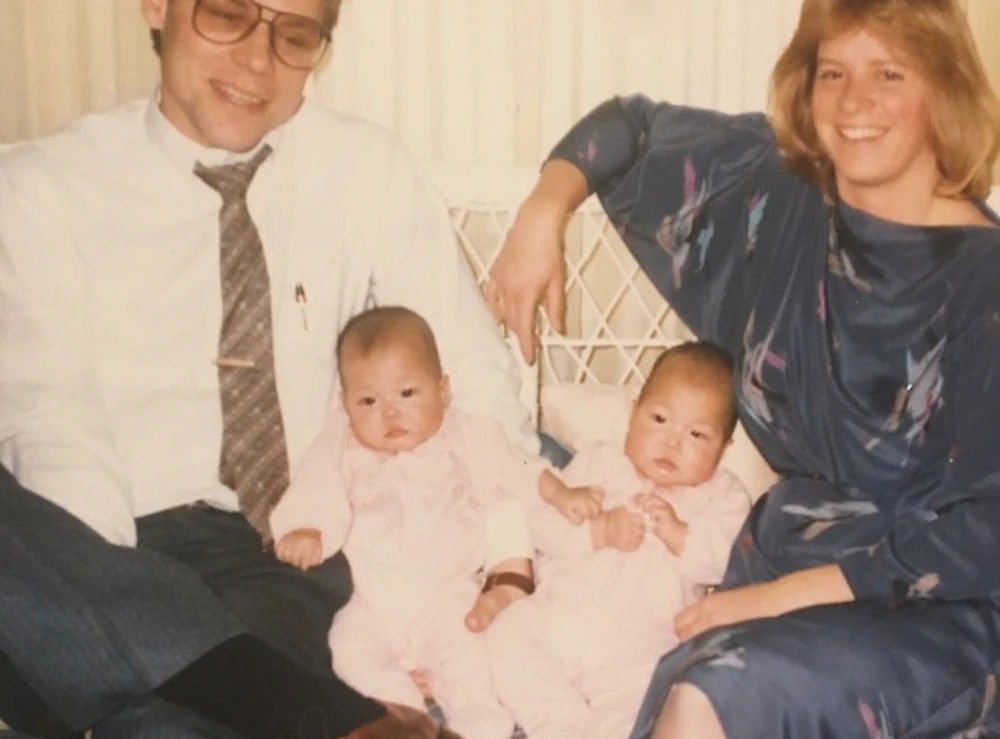
During the eighties and nineties, South Korea sent an estimated 200,000 children overseas for adoption, mostly to white families in North America and Europe. Right before Christmas, my twin and I boarded a plane to Detroit, Michigan, touching ground in the evening, during a blizzard. Now five-and-a-half months old, we’d over-doubled our weight—10 and 12 pounds, respectively. We were carried off the plane through the jetway and placed into the arms of two 30-year-olds.
The video footage from that day is grainy, but my parents’ smiles and my grandparents’ tender gazes are crystal clear. Years of heartbreak and empty arms, mended by two baby girls. “Double the trouble,” friends would say with a wink. “Double the blessing!” my parents replied.
Was it, for you, double the grief? Did giving away two daughters break your heart twice over?
Along Lake Michigan sits a string of small towns founded by Dutch settlers. Perhaps extremely homesick, they named the town after the place they’d left: Holland.
In many ways, Holland seems plucked out of a storybook. (In fact, it inspired The Wizard of Oz whose author L. Frank Baum spent his summers there.) Peppered with windmills and tulip-lined streets, you’re never further than 10 minutes from a beach and summer sunsets stretch well past nine pm.
Growing up in Holland, Michigan meant that in addition to a typical Midwest upbringing of casseroles, small-town charm, and desserts that cosplay as salads, Dutch culture threaded through everyday life: white bread topped with De Ruijter sprinkles for breakfast, your mom calling underwear “broekjes,” and Tulip Time—an annual tulip festival celebrating Dutch heritage.
Alongside parades and carnival stands selling oliebollen—literally translated as “fat balls,” a detail that brings middle school boys and my husband endless delight—hundreds of high school girls lined the streets to perform traditional Dutch folk dance in full costume. This is how I came to find myself in National Geographic.
Every now and then, people ask if I always knew I was adopted. Not to bury the lede, but my parents are Dutch. They have light hair and blue eyes. Ethnically ambiguous, they are not. I’m number 25 in a line of 32 first cousins, and blonde-haired, blue-eyed towheads are the rule in our family, not the exception.
From day one, my parents made clear how desperately they wanted me, my sister, and our (later adopted) brother. I never doubted their love. But a parent’s love alone can’t keep you anchored in a sea that constantly reminds you you’re different. It’s embarrassing to admit this, but in the spirit of honesty: I don’t remember ever being proud of being Asian. Not once. Being Asian felt like my scarlet letter. For years, I tried to hide it and when I realized I couldn’t, I did the next closest thing: assimilate.
In 5th grade, that meant performing a nightly bedtime ritual. As I drifted off to sleep, I’d pull at the skin around my eyes, trying to create a deeper fold in my eyelids. Maybe I’d wake up looking a little less Asian. In 7th grade, I filled out a questionnaire on racial diversity at my school, only to realize later I’d answered the questions as though I was white.
How frequently do you interact with people of a different ethnicity from yours? Rarely.
How often are you in the minority in the classroom? Never.
Mind you, I graduated with nearly 300 peers, fewer than 10 of whom were non-white.
I went to college in my hometown, which is to say, college didn’t exactly diversify my environment. I remember feeling absolute victory when one of my friends laughed, “Nicki, you are seriously the whitest Asian I’ve ever met.”


Whether imagined or real, I became convinced that I could never be as pretty or desirable as my Dutch counterparts. I felt destined to be the supportive sidekick, never the beautiful lead.
We’d crowd around the glossy photos we picked up from the one-hour photo counter at the grocery store. Any picture with crinkled or half-closed eyes prompted the same reaction: Oh my gosh, why do I look Asian? You can’t even see my eyes.
A friend once mentioned she thought the Korean guy on our basketball team was cute. The other girls laughed. “Wait, him?” they asked incredulously, as though finding an Asian boy attractive was absurd.
When I was 16, one of my close friends confided in us as we sunbathed at the beach: “My mom and I rated the girls in our class by how pretty they are.” The prettiest, they concurred, was a girl named Corrie. Pale blue eyes, perpetual tan, and what we called “dirty blonde” hair in the aughts—rebranded to “old money blonde” today.
As my friend rattled off the names of some of the other candidates, she mentioned a Korean girl—also adopted—named Lydia. Lydia had long, jet-black hair and creamy skin that to this day has probably never experienced a zit. Her smile was wide and easy and her eyes were the color of a double espresso.
“We considered Lydia,” my friend admitted. My heart lurched. Calling Lydia pretty felt akin to calling me pretty, which had never happened. “But…” her voice trailed off. She tilted her head to the side. “You know…” She gave me a look. I knew what she was saying without another word. “You know…she’s Asian. And Asians just aren’t as beautiful.”
Do you ever feel beautiful, just absolutely stunning? Do you tilt your head in the mirror trying to catch your good angle? Slip into an outfit and give yourself a grin and an approving nod?
After 20-something years in Holland, I moved to Philadelphia for a job in fashion. For the first time ever, I didn’t feel like an outsider. Working in fashion in a large city exposed me to people from every imaginable background—not just ethnically, but socially, creatively, and religiously. There were queer designers, trust-fund heirs, stylists wearing underwear as shorts to the office cafeteria, and people who discussed astrology with the same seriousness my hometown reserved for church potlucks. (The first time someone asked me for my sign, I stared at them blankly, “Uh, come again?” For the record: Cancer Sun, Scorpio Moon, Pisces Rising.) Difference wasn’t something to overcome there. It was ordinary.
In case this wasn’t abundantly clear, I had not exactly been fighting off potential suitors back home. Then, my first weekend in Philly, I met a boy—on Valentine’s Day hilariously. Fast forwarding very quickly here, that boy and I became close friends which turned into falling in love; “I Do”; and let’s have a baby.
Eight years after meeting that boy, I got pregnant. As everyone’s excitement grew, so did my anxiety. Not about becoming a mother, or how dramatically my life would change, or the fact that I—a devoted lover of sleep—would soon get very little of it. No, I was anxious about what the baby would look like.
I’m ashamed to admit it, but I desperately wanted my baby to look as least Asian as possible. My ethnicity certainly didn’t serve me much in my first 31 years of life, did it? Please, God, spare my children.
“One more push,” my midwife cheered. “Oh my gosh, he’s got a lot of hair, Nicole!”
When they lifted my firstborn up like baby Simba, his eyes were wide open. He looked a little bit startled. I didn’t blame him—after nine months of growing in my dark, cozy womb, fluorescent lights and humans in scrubs are not the most gentle entrance into the world.
I scanned his face. He had my cheeks—the ones I’d despised my whole life—and my eyes—the ones I’d despised my whole life—and the dark hair I’d colored for years in an effort to look less Asian.
And he was the most precious thing I’d ever seen. I couldn’t believe he was mine. I loved him with a ferocity that made every cliché about motherhood and your heart living outside your body suddenly make sense.
Did you memorize my face the way I memorized his? Did you breathe in my scent and whisper things I’ll never recall? Did you weep when your milk came in, when your arms were empty, when the blood flowed out—the remnants of us swirling, swirling down the drain?
Biology announces itself in strange ways. There are certain things you just can’t manufacture. If you were raised in a biological family, comments like “You look exactly like your mom!” may feel commonplace. I imagine they have the same effect as, “I can’t believe how much you’ve grown!” Nice, but not really memorable.
Now imagine you’ve gone your whole life without hearing those things. When people tell me they see me in my children, I drink it up. I don’t get tired of it. Give me a “they have your [insert anything]” and boom, you’re in, we’re friends.
My second-born has my lips, full and pouty. The profile of my oldest when he sleeps is eerily similar to my sister’s. The expressions that cross my baby’s face make my Mom laugh. “You look just like your mama,” she cooed.

"He had my cheeks and my eyes and the dark hair I'd colored for years in an effort to look less Asian. He was the most precious thing I'd ever seen."
There’s that quote from James Baldwin that says, “Children have never been very good at listening to their elders, but they have never failed to imitate them.” The biggest surprise that’s come from having biological children has been my own desire to accept myself more, the parts of myself I spent years trying to erase.
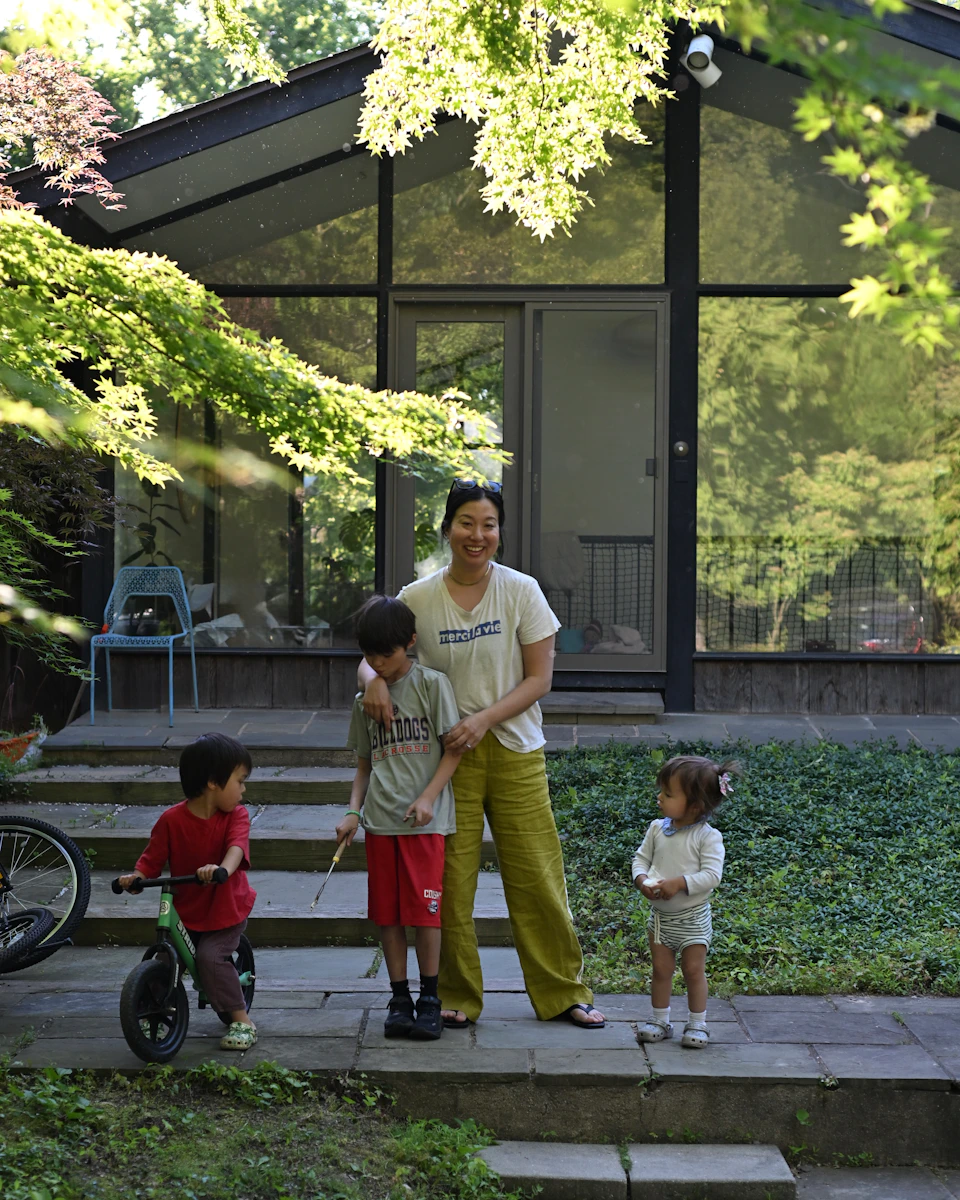
The other day, I watched my two-year-old playing at my vanity. As she tried to open my face creams (I close them tightly for a reason!) and ran a blush brush over her chin, she looked in the mirror and smiled at her reflection.
We’re nearly twins—people comment all the time. I think she’s gorgeous. Nothing would break my heart more than her believing she’s not beautiful because she learned I struggle to believe I am. I wish I could say that when I look in the mirror, I smile the way she does. I wish I could say that I look at my face and see an Asian woman I’m proud to be. I’m not quite there yet. But for her sake, I’m trying.
I check my tone of voice when someone asks me “where I’m from.” It used to climb an octave in an effort to sound easy and breezy, though it probably came across as apologetic and ashamed.
“I grew up in Michigan,” I’ll say cheerfully. And when the inevitable “No, but where are you from?” follows, I tack on the facts: I was born in South Korea and adopted as a baby. No, I haven’t been back, but lately I’ve been thinking about it more. Maybe we’ll tack it onto a Japan trip? My oldest loves Pokemon.
We talk to our kids about heritage the same way we talk about our weekend plans:
“Clay, remember how Mama was born in Asia?”
“Um, I think so?”
"Did you know rice is really common in Asia? We should try Korean food sometime."
“Yum, I love rice. But can I have mac and cheese today?”
Around six months ago, I obtained my official paperwork from Holt, the adoption agency that handled my sister’s and my adoption.
My file held details I never knew. I spit up a lot. I smiled. I didn’t nap well. I loved my bottles. I drank barley water in between feedings. I slept soundly during naps. Some things never change.
Once I received my file, I submitted a request for reunification with my birth mother. Reunification simply means establishing contact. For me, it came from curiosity, a few medical questions, and a decades-long desire for her to know that I’m okay.
Birth parents can choose whether to accept contact or decline it. If they decline, the agency cannot reach out again. Holt sent a letter to my birth mother—the first attempt at contact in nearly 40 years. A few days later, she called them back.
She has low blood pressure and high cholesterol. She’s no longer in contact with our birth father. She was happy to hear we were doing well.
She declined contact.

“Sometimes birth mothers change their minds,” they told me, “after they’ve had time to process hearing from a biological child.”
Was it a shock, hearing I’m alive? That I’m okay?
I lost a baby in 2020. We named him Leo. I delivered him stillborn, sobbing through that final push as he entered the world. I didn’t hold him. I never touched him. I will ache for him for the rest of my life. And yet, life carries on.
Did that final push break your heart the way it shattered mine?
Nicole Prince is a fractional head of copy and the writer behind Double Dutch, a Substack about career, motherhood, friendship, and figuring out what comes next. She writes about the things she wishes more women were sharing out loud: money, ambition, reinvention—and the equally important matters of what to wear, what to make for dinner, and how to travel well without spending a fortune. She lives outside Philadelphia in a seventies fixer-upper with her husband and three kids.