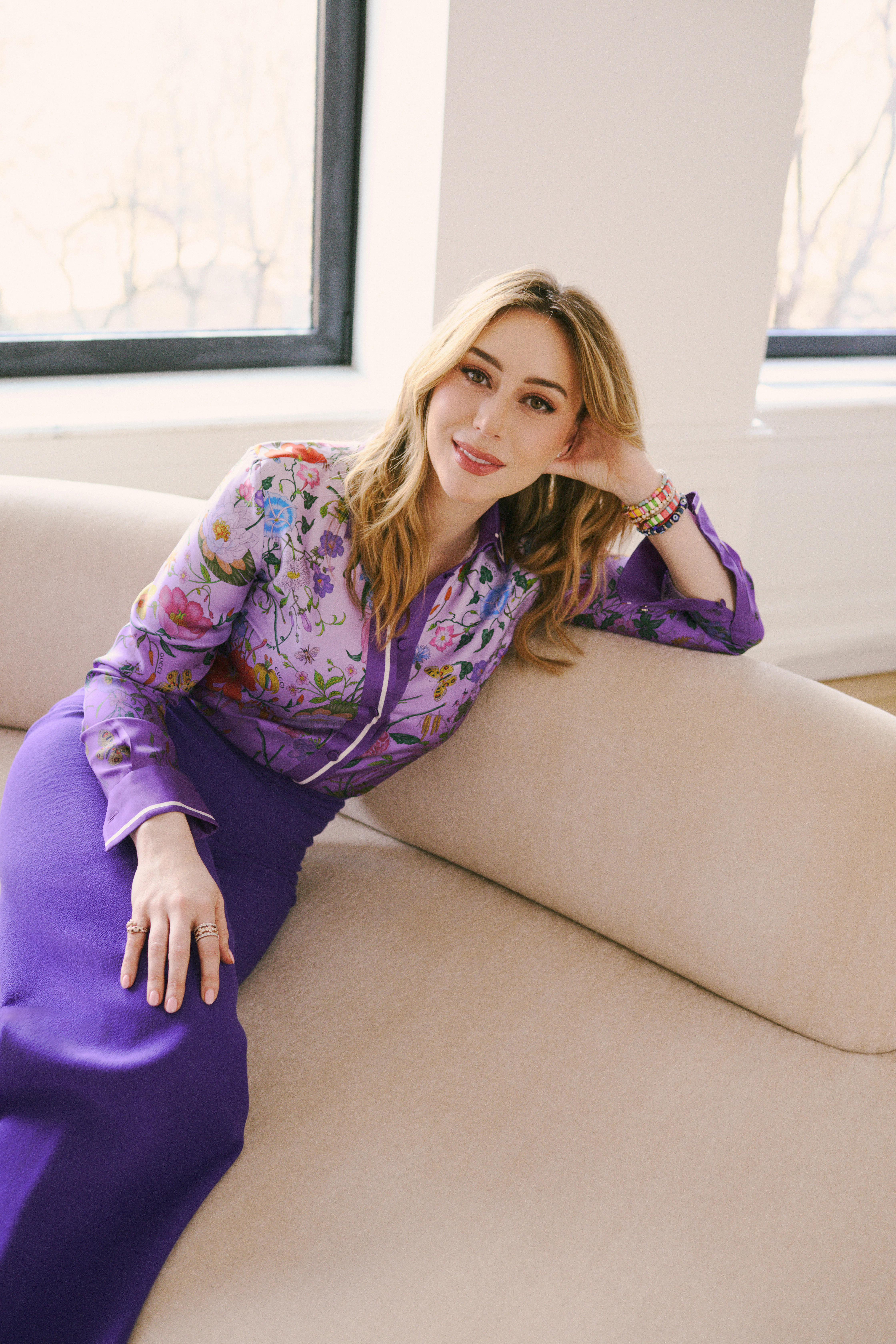
Getting Sticky with Dr. Shereene Idriss
One of New York City’s preeminent dermatologists and certainly, the Internet’s and our favorite, Dr. Shereene Idriss is a rare combination of brilliant authority; much-needed humor; and deep-seated honesty on topics like IVF, vanity, postpartum, and of course, SPF.
Dr. Idriss thrived through medical school, residency, and the grueling training required to become one of Manhattan's most sought-after derms. She built a career in a profession that runs on timelines: four years of undergrad, four years of medical school, followed by residency and fellowship. Study hard enough, work long enough, and eventually the pieces fall into place.
Was trying to conceive and motherhood as cut and dry as that? Not quite, she learned. Below, she talks about why rescinding control as a mom is necessary; her own IVF journey; and the reason she won’t keep full-length mirrors in her home.
Images by Shana Trajanoska. Words by Emily Barasch


“Just relax”—yeah, right
My journey did not happen easily, linearly, or quickly. For many years I wasn’t ready for kids. Obviously, I'm a physician, a dermatologist, so I was in med school, then in residency, and then I got married. It was really about how can I, at least, make sure that I don't get pregnant quite yet.
But then, it took years. Years of trying when I was finally somewhat emotionally ready to try to get pregnant, it never happened. There was a lot of uncertainty, there was a lot of quiet heartbreak, there were miscarriages, and this narrative of: You have to relax and it will just happen. For many of us, it just doesn't happen. Ironically, I used to think: Oh wow, I'm going to get pregnant very easily because I'm curvaceous. My period has always been on time…
The key word is humbling
I've had intense pains thinking they were normal, not realizing at the time that I had endometriosis or fibroids. I just thought all of that was normal. I thought: Okay, I'm just going to get pregnant like everyone else. And it just never happened. Ultimately this fundamentally changes a person because even before I did IVF and even before I knew how much I wanted to have my kids, just the fact that I was trying and I couldn't, it changes your whole perspective. When you finally do get pregnant, you think: Okay, I made it, but then life humbles you again. Whether it was finding out I had placenta previa, having major bleeding and going on bed rest. And then life continued to humble me—I got fired when I was pregnant with my first.
I was undergoing IVF and shooting myself up, and if ever you've undergone IVF, you know that when you first inject that progesterone, you get super emotional. So every morning, I was a complete emotional mess. You realize very quickly even before becoming a mother that control is a complete illusion. When I finally entered motherhood, it was not from a place of stability at all. It was not from a place of control, it was just kind of from a place of letting go and just being happy when I met my daughter that she had all 10 fingers, all 10 toes, and she seemed healthy. It was the most basic things that just brought me joy.
I've gone through med school, I thought I was resilient enough, but the whole process of motherhood—med school was nothing compared to that. It made me much more resilient, much less tolerant of BS. It forces you to let go of timelines. As a doctor, you're so married to timelines because [it’s] four years of undergrad, four years of med school, then you have residency, and then you know what you're doing. But in life, that just doesn't work. As a woman, especially not. You realize that life really doesn't follow your plan. It was just learning how to trust yourself over and over again.


"I've gone through med school, I thought I was resilient enough, but the whole process of motherhood—med school was nothing compared to that."
Getting fired while pregnant <<<
It was awful. I was very much caught off guard because there was nothing leading up to it. There was a difference in opinions in terms of chemistry between two people. It was a very hard time, but ultimately, I like to look back on it as a bulldozer moment in life when I was stripped of everything. I just had to figure out how to keep going because my daughter was with me, secretly at the time, but still with me. Even though not so secretly, because they knew, it was like 10 weeks. It really forced me to figure out how I can show up for myself, but also for her because me having a panic attack was not going to serve her in utero, and I wouldn't want her to come out to see her mother a mess.
She really was my little miracle. I called her Mila, which is short for milagro [the Spanish word for miracle.] She was my miracle because when I had her inside of me, I felt like I had to keep going no matter what. Had I not been pregnant, ironically, I don't know if I would have been as strong. Ultimately, you find your strengths in times of weakness, right? That was a real bulldozer, force forward moment for me that has set the tone of pretty much everything else that has come in my life personally and professionally.
At the beginning, we all lose it (a little bit)
I remember when my daughter was born and I had to go back to work because, again, I had just started a new job. I was literally back at three or four weeks postpartum because I didn't want to lose what I was trying to rebuild.
I had a nanny, and I asked her, "Please listen, we're in New York City, you're in the stroller, make sure you stop three feet before the end of the sidewalk in case a car turns. I don't want it to hit the stroller…” and she was looking at me like I was crazy. Then I told her, "Also, don't go left on the street above us because there's a liquor store and people around liquor stores might be drunk and you don't want the baby next to that. What if they come and swing at the stroller?" I also wanted to put a tracker on the stroller. Actually, two trackers on there in case one falls.
Like, I was nuts. Nuts. I had to again talk myself off the ledge and take a beat, you know? You can't control everything. You succumb to realizing that you're not in control of everything, you have to have faith that things are going to be okay and they're going to work out. But the stress that I was imposing on the nanny and also my baby…
I was really stressed for the first few months beyond what should be considered “normal.” It was hard. I wasn't that much of a nervous Nelly before I had my daughter. But seeing how hard it was to get my kids and bring them to this world and everything I had to mentally and physically go through in order to meet my children, I got very, very anxious when they were first born, especially with my first.
With my son, I had learned already how to let go and I was much more easygoing, then COVID happened, and then I had to let go again. Because at that point, it was like, what am I going to do, you know?


[Ed. note: The editor fully cried reading the below]
Honestly, it's like my great-grandfather used to say, "Each pregnancy's like a watermelon, you just never know what the inside's going to be like." I think a lot of women particularly don't share how hard a first child is. Especially the aftereffect where you're like, "Oh, the baby's here. Now what?"
That fourth trimester is a whirlwind; it is exhausting and mentally draining. Of course, it's rewarding and beautiful and there's a lot of love, but for a lot of women, they're too scared, shy, or embarrassed to say that they hate it. This comes up every single day in my practice. Believe it or not, women feel very safe because it's just me and them in between four doors, and especially the new time, first-time moms. When I close the door, I don't even ask how the baby is because I know what that felt like. It was just like, "How's the baby?" I always prefer to ask: "How are you doing?" Women get forgotten.
Then, I look at them, and either their eyes well up and they want to start crying, and I'm like, "It's going to get better. I promise." And then, they just start balling, because they think, “no one told me it was going to be like this." So many say that exact same line, and it's so sad because it's not spoken about and women are made to feel bad if they feel like they're not as excited or as happy as they “should” be in those first few months. But it's a lot.
Your hormones are crashing faster than they crash through menopause. You're emotionally all over the place, your body just went through some crazy ordeal, and now you have another human who's fully dependent on you. If you don't feed that baby, who's going to feed the baby? How is that baby going to survive if not for you? You've lived your whole life never thinking about another human who's fully dependent on you. So, it's a huge shift and it's something that's not often spoken about in that light because I think there's a lot of shame around feeling that way, which makes women feel even more isolated in the process.
I say this as somebody who had to fight to have her kids, it was not given to me. I wanted my daughter so badly, and I am so grateful I have her, but those first few months were an emotional rollercoaster for me where I felt so bad and I felt so guilty for not being as joyful as I thought I should be. I probably was my biggest enemy during that time, which made my anxiety even worse, because I was trying to compensate for not being so.
What no one admits
This is something that a lot of people don't admit. With my daughter, even though I wasn't as happy as I thought I should be, I thought I was in love with her.
Then I remember when she was eight or nine months old and started smiling and interacting more with me. That's when I think I really fell in love. And I remember thinking, wait, I wasn't as in love with her as I thought I was.
You're in it. You're really in the thick of it. So, you should give yourself some grace and not try to achieve everything. Your definitions of things are going to constantly evolve, and I think you have to be okay with things evolving and shifting in ways that you did not anticipate.

"I also emphasize that as a cosmetic derm, I'm very sensitive to issues of vanity. I never want my daughter to think that beauty is the ultimate goal or the only goal."

What we show our daughters matters
I'm a skincare brand owner, and I started working on it when my daughter was three. But I didn't want her to always think that [her appearance] is the only thing she needs to worry or care about in her life. I brought her into the conversation so she could feel like she was helping me create. I think she views skincare through a creation lens, she’d ask: "What is the function of everything that you're using?"
I feel lucky that she hasn't been sucked into FOMO and—and peer pressure yet. I speak to her about it a lot and I also emphasize that as a cosmetic derm, I'm very sensitive to issues of vanity. I never want her to think that beauty is the ultimate goal or the only goal, of course. From my perspective, I make it a point to always tell her, "You know, what matters is really your inside. No matter what."
I actually have zero full-length mirrors in my house because I don't want her to see me catching myself. I think that feeds into insecurities especially as young girls get older. In the bathroom, I try to do my skincare relatively quickly, especially if she's around or my makeup, so it's not like she thinks you have to spend hours getting ready.
Wading through fear, finding balance
It's terrifying, especially when you first get pregnant after struggling to conceive and having gone through IVF. I remember when I first got pregnant, I'd be like, 'Oh my God, I don't want to walk behind the city bus. Am I inhaling fumes? Oh my God, what am I eating? Is there microplastics? Oh my God, what am I putting on my skin?'
So, I completely identify with and understand the fear. But my job—with myself and now with patients—is to take a step back and look at the big picture as a whole, and to realize that the more you feed into the fear, the more you're going to stress yourself out. You have to have a balanced approach to life. You're only doing yourself a disservice if you're making your decisions through fear.
Given that that's my overall philosophy with patients and life, I had to have a talk with myself when I was pregnant because it was a scary time, especially when it took so much to get pregnant. It's really about simplifying the information that we have and clearing the misinformation that's out there without dismissing any real potential risk.
“I was watching, thinking: Wait, when can I afford a kid?”
Balance is not about how much you can accomplish in a day. I view balance in a weekly overview. Am I seeing my kids more throughout the course of the week than I wasn't? Am I trying to give them that quality time versus the quantity? Am I having dinner at home more often than I'm not? Am I taking them to school more often than I'm not? Have I seen more of their plays than I've missed? I use a bird's eye view to assess what I’m doing. I try to stick to it and really look at the macro and not the micro of things.
My co-resident had her first kid during residency, and I was in awe of her, but I saw how much she struggled. It's not just the time factor, it's the financial factor. With med student loans and making a very minimal salary as a resident. I was watching, thinking: Wait, when can I afford a kid?
I have the most respect for single moms who are doing this completely on their own and I am in complete awe of those humans. But [having a baby was a] question of finances and when can I afford it. By the time I finally felt comfortable even thinking about potentially getting pregnant, I was already in my early thirties. I still hadn't really lived life because I was always studying. I wanted to travel, I wanted to make sure I felt free with my husband, who I finally can live with, I wanted to be able to experience life a bit before we get a child. There are so many things that women have to think of, especially female physicians, that are really not spoken of.
It sounds like a champagne problem but I would ask, "How do I find a nanny?" But it was a necessary problem because without the nanny, I wouldn't be able to go to work. Because I didn't have friends who could watch my kids, I didn't have family who could just pop in and just be there. My husband was traveling all the time for his work, so I couldn't just drop my daughter on a dime.
I love being a mom and I love my kids, but it was not something that came naturally to me, no pun intended—you know, IVF. Where there was a lot of emotional turmoil in the beginning years, now things have now gone a little bit easier. But with every age, there's a different turmoil that you're just not ready for because you obviously don't know what's to come. Whether it's their friends making fun of them or they don't have friends or they have too many friends or whatever. You're never going to be in control over that, and if you're trying to create the perfect image of it, you're going to set yourself up for disappointment. But it's still a beautiful thing to be living and it's the biggest privilege of my life to be a mom and to be able to witness like these two little things grow up into very beautiful people who give back to this world.


Being a mom will change your skincare routine
My skincare view shifted once I became a mom. My kids are 19 months apart. I was trying to stick to a 10-step skincare routine, but it was quickly proven to be not just complicated, but impossible. If a routine looks good on paper but it's not something that actually fits your life, it's impossible for you to adhere to it, and if you can't be consistent with it, you're never going to see results. My advice to any mother or any really any human is you really want to be as consistent as you can possibly be for yourself seven days a week, 365 days a year in order to reap the benefits of what you're doing.
When it comes to my kids, I'm trying to teach them the basics of self-care and hygiene in the most positive way, which is cleanse, moisturize, SPF. You want to wash your face after a crazy day you're playing in the park, get the dirt off. You want to moisturize just based on the time of year. Is your skin feeling dry or is it really hot outside and humid that you don't need it. My kids are trying to understand just those light basics.