A Mother’s Reflections on Terminating Wanted Pregnancies
Words by Jayne Pillemer
On Father’s Day of 2018, my husband and I hopped in our four-door sedan at dawn and fled our home state of New York. Lady Liberty seemed despondent in the rearview mirror as we picked up speed going south on I95.
Well, we couldn’t exactly see Lady Liberty because we were coming from Westchester, but it’s the metaphorically-speaking part that’s important here.
And I didn’t exactly hop in the car. It was more like a slow, sideways ease.
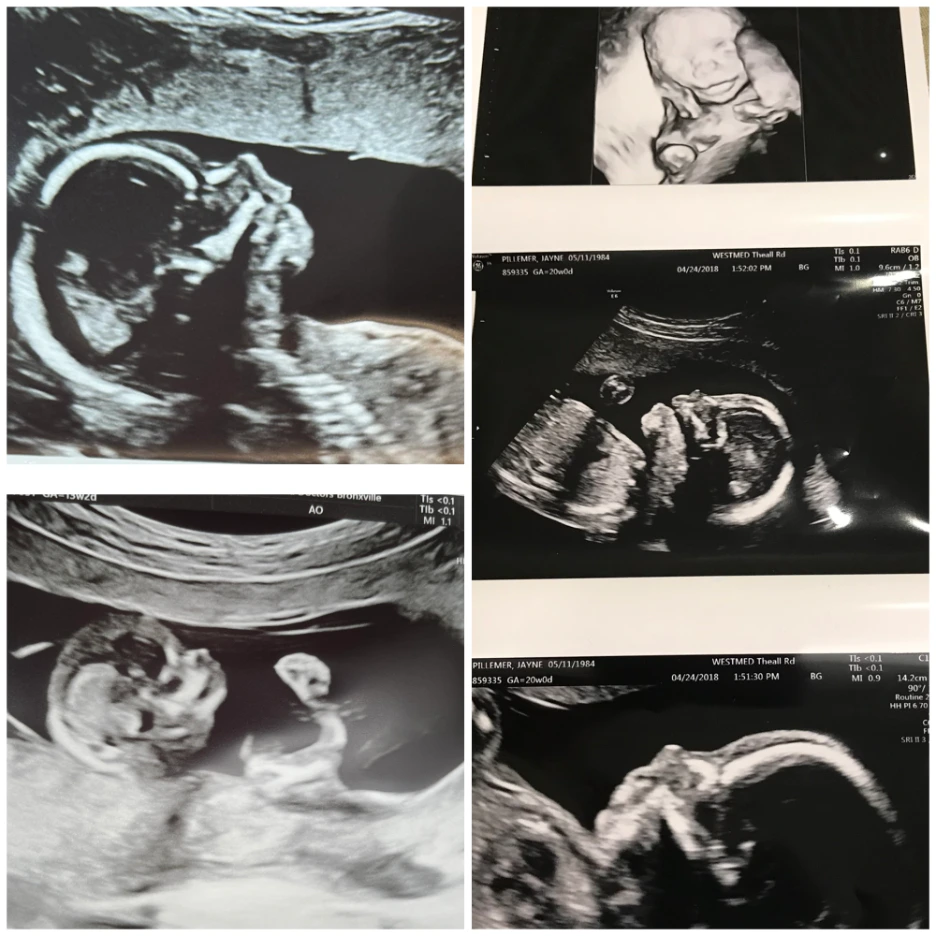
You see, I was almost 28 weeks pregnant with a desperately-wanted, already-beloved baby girl. A baby girl for whom the sweetest floral nursery bedding had already been ordered. A baby girl with older brothers who loved to look at her “baby x-rays” (otherwise known as ultrasound photos). A baby girl who had just received a life-limiting, pain-inflicting, rare genetic diagnosis. But we had been turned away from care in New York due to a 24-week abortion limitation.
The destination on our GPS was Bethesda, Maryland. In a matter of hours, we would meet Dr. LeRoy Carhart, one of the only doctors in the country licensed to perform third trimester abortions at the time. He would begin the process of terminating this pregnancy and inducing labor, which would culminate in the delivery of our stillborn daughter.
We had held onto hope for our beloved baby girl since the first red flags about her health were raised at her 20-week anatomy scan. We held on as we spent the ensuing seven weeks meeting with specialists, geneticists and Maternal Fetal Medicine doctors for ultrasounds, bloodwork, EKGs, an amniocentesis and testing. Termination was brought up, but I struggled to make that choice in those weeks, when it felt like there was a chance that the outcome for her life might be okay. If there was anything I could do, from NICU support to therapy to medication to a surgery that would give her a chance at a life with quality, I would do it.
And then came the diagnosis—and the explanation of that diagnosis—that taught me something I didn’t know, even after delivering and raising two other children: I could give birth, but not give life. I could love my child to the edges of my toenails but still not be able to comfort or protect my child. Abortion could be the most powerful expression of a mother’s love for her child, and it would be mine.


We arrived at the over-crowded abortion clinic in Maryland. The kindest doctor I had ever encountered walked me through the procedure. I dodged protesters. I labored in the hallway with a herd of other mothers terminating late in their pregnancies for similar reasons. I accepted the minimal pain management that was offered. I delivered my precious girl in what appeared to be a repurposed dentist’s office. I recovered in a LaZ-Boy for about sixty minutes.
I was too afraid to hold her—too afraid that if I lifted her body to mine, I’d never be able to give her back. That my arms would crave her physical presence as much as my empty belly did. So my husband and I sat with her body and soaked up her soul, which I felt lingering nearby.
A week later, I had a vivid dream, so tangible and memorable that I can only describe it as a visitation. In the dream, a healthy and happy teenage girl ran toward me. I knew it to be my baby immediately. She was dressed in a violet sweater and light-wash denim jeans. Her light brown hair was loose and straight down her back. She came toward me with her arms outstretched and we hugged, a tight and weighted embrace that I could feel. As I squeezed her, her body disintegrated and began to fall like purple pixie dust toward the ground. From the dust burst a spray of butterflies, their purple wings fluttering up through my arms and into a periwinkle sky. I woke up and distinctly knew my daughter thanked me and was free.
My heart was relieved for her, but broken for me.
The world has told me that time heals all.
The world doesn’t seem to know that mothers never stop missing their children.
In 2022, the Supreme Court ruling of Dobbs v Jackson overturned Roe v Wade, undermining the autonomy of women of child-bearing age and sending even more pregnant mothers making compassionate choices for a multitude of reasons on a journey of planes, trains and automobiles. My heart broke a little bit more.
And then, it happened again.

"Why was my autonomy dictated by an arbitrary cut-off date?"
In late 2022, I was fourteen weeks along with another baby girl when the geneticist called and said there was an unexpected finding on the baby’s Genome Sequencing, which we had opted to do after suffering such a horrific previous loss. It was a tough diagnosis. Unrelated to our previous daughter’s diagnosis. Incompatible with life.
It couldn’t be. Not again. But it was.
I was so angry at letting myself get attached to her when I knew this could happen, so angry at myself for celebrating this pregnancy when I knew this could happen.
But here’s the thing: loving this baby wasn’t a choice. It was just something that happened for me—and in many cases, doesn’t happen. The instant I knew cells in my body were dividing, I felt the great hope of her. I could steel my body and numb my mind to the anxiety that pregnancy now brought, but I couldn’t change the fact that I wanted her—and I wouldn’t have been able to change it if I didn’t. Whether she remained there or arrived here, I loved her and knew the choice I had to make again was rooted in my compassion and unconditional love for her.
Despite the fall of Roe, New York’s abortion legislation protected my right to choose at this point in my pregnancy. The fact that the government had trust in my decision-making when I was 14 weeks pregnant but didn’t have trust in that same decision-making when I was 28 weeks pregnant confused me. Why was my autonomy dictated by an arbitrary cut-off date?
I went for a dilation procedure, and then to a local hospital for a D&E. It was a different experience, being in the hospital. More convenient. More dignified. More lonely.
I sank into sadness; my soul felt the painful rip of my baby and ached with the emptiness of her spirit.
And then the girls began to send me pennies. On a walk around the neighborhood: a penny. Stepping out of the car in the Target parking lot: a penny. A penny here, a penny there turned into a penny almost everywhere I went. My coat pocket was soon heavy with them.
I realize I sound totally woo-woo. But how can our world insist that mothers are called to love their children on the highest level and not trust that we can communicate across these planes of spirituality? The girls were grateful to me, and now they were telling me luck or at the very least something like it was coming.
I have a baby girl in the world now. Her name is Lilah, but at home, we call her Penny. Her being healthy and alive feels like being loaded with luck.
And the joy of her. Oh my god, the joy of her.
This might sound like a sad story with a happy ending, but it is just a story with parts that will always be sad and parts that will always be happy. The stories of my daughters lost to abortion don’t have endings, because I’m still evolving from those losses. The birth of my healthy daughter hasn’t magically made the sadness and trauma of those situations go away, because living people don’t make up for the loss of dead people. That’s grief. My heart is still devastated that my first two daughters were so sick. But it also beats for my living children, and it loves them all equally.
The Dobbs decision allows states, without public vote, to embrace abortion as black-and-white and to determine that all the important cases fit into a slender and tidy box of exceptions.
It's interesting how old words take on new meaning and new words are added to the dictionary as trends hit and times change. Meanwhile, abortion continues to be defined by the politics that have flattened it, rather than by the people who have experienced the many nuanced situations that lead to such a tender decision.
In our home, and in many homes and hearts across this country and around the world, abortion is an act of compassion. As more women and men tell their stories of abortion without shame, just with respect for responsibility, trust in self and belief in spirituality, we tip-toe toward embracing abortion for what it is: an expression of love.
Shhh. If you listen, you might hear it from me in my daily whisper: “Hi, my babies. It’s Mama. I love you.”
If I’m too far away, stay quiet, and you’ll most definitely hear it from another perfectly lovely woman who passes you by.

Jayne Pillemer is the author of Still Mine, (HarperCollins 2022), a picture book about love and loss, that has been featured in Oprah Daily and called “tender and touching” by Kirkus Reviews. She is the mother of four Earthlings and two angel babies and is working on her memoir, A Love Letter to My Daughters, about terminating her much-wanted pregnancies. You can find her on Instagram @JaynePillemerbooks.