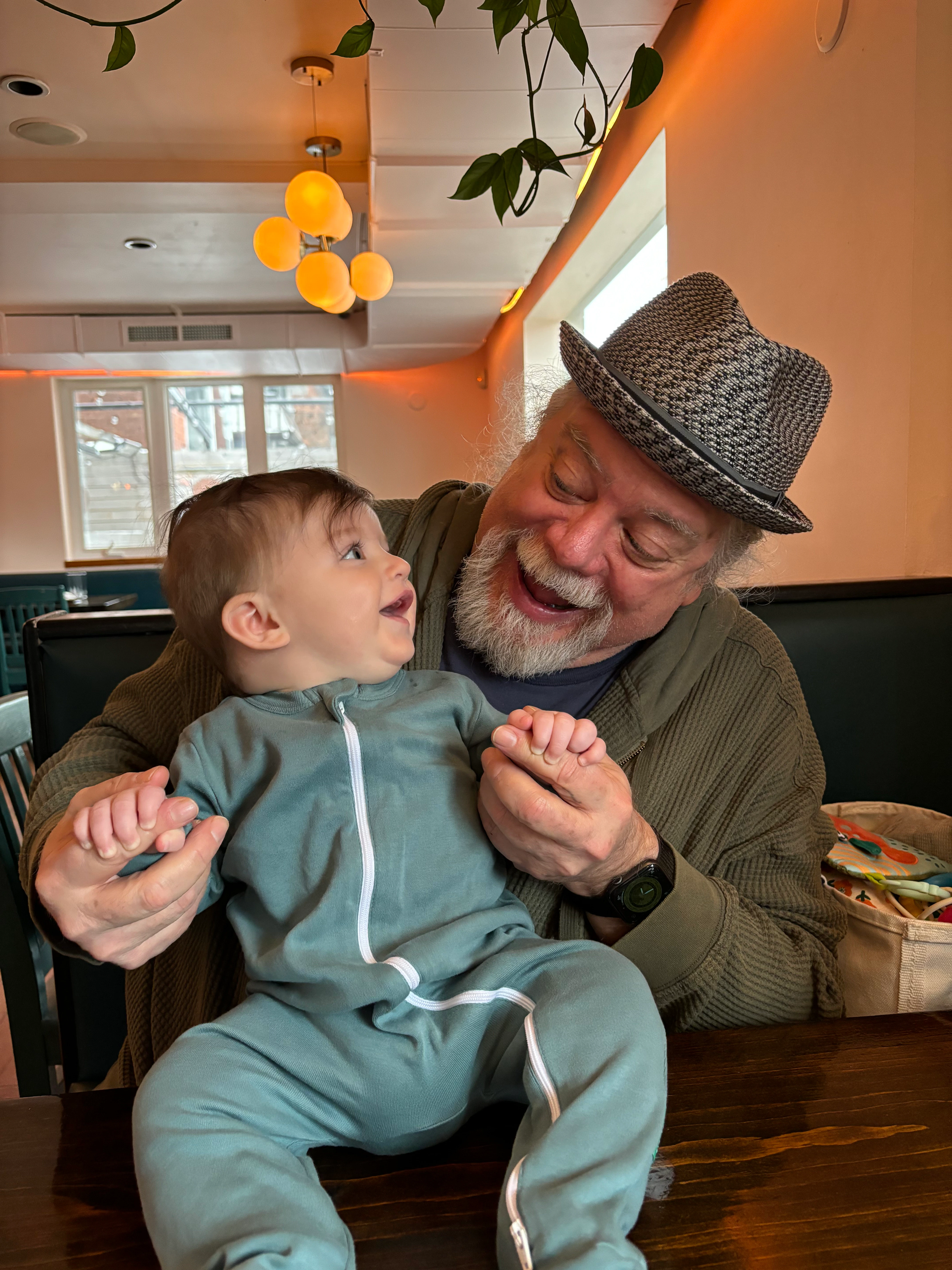
Living With Opa
Words by Ruby Dallas
Before he was Opa, my dad and I weren’t in a great place. This was right after he completed a four-year fine arts degree at 60, leaving him feeling aimless and considering more school, which, to me, meant more debt and more worry. I had grown up internalizing his perennial money problems since I first understood what rent was. My dad has always been a rolling stone. He runs a business decorating thematic porta-potties for festivals and has been in a performing trio called “Men in Tights” since the eighties, doing audience-participation-based Shakespeare plays at street festivals and Renaissance fairs. My parents (long divorced) met touring as street performers. I am their only child and I am, in most of the ways that matter, a normie. I have a normal job, a long-marriage to my partner who I met nearly 12 years ago when I was 21, and I have made choices to design my life towards the ever-shiny goal of stability.
We didn’t speak as much as usual during my pregnancy. This was strange to me, because my dad is a talker. He talks to strangers in line at the grocery store, he talks to dogs and children on the street, he talks for a living. Not many years earlier, especially during COVID, we would have near-daily phone calls where I would update him on the intricacies of my life, my stressful job, which was, at the time, mainly related to dealing with the families of dying seniors. Those phone calls all felt so easy and he was always available to chat. He listened and took the opportunity to go on and on about whatever he was reading about that day. Not infrequently, the conversation would return to one of his pet topics, music history. He exposited at length about an obscure Talking Heads B-side. He told me, “They wrote this because one of the band members’ babies wouldn’t sleep, the baby was up at two a.m., and they needed to write and record. So, they sang, ‘little baby goes ha all night long, all night long,’ to get it to sleep. They brought the baby into the recording studio!”
It sounded like this Talking Heads’ baby’s childhood was not dissimilar from my own, and maybe, unbeknownst to him, he was using the song to reminisce about some unspoken parallel in our own family. My first five years of life were spent mostly in hotel rooms and vans and in billets across North America. A billet is, for the unacquainted, a free place to stay provided by good Canadian Samaritans supporting theatre festivals across the country. The hosts get free tickets in exchange for letting a bunch of homeless artists stay in their houses. Or, in my parents’ case, homeless artists and their small child.


"Living with a parent in adulthood is not for the faint of heart. There’s a lot of giving and taking on both sides."
The tumult of my childhood would be exciting if I knew it to be any other way. I was jealous of kids with routine (and siblings). My world was always picked up and turned around, and home was everywhere. Lots of back and forth, moving around, bad stepparents and quite a bit of loneliness. Always well-loved, not always well taken care of. Yet for a while, things felt somewhat stable with my dad. When I was 11, he moved to a suburb with a now ex-stepmother and suddenly, life felt more suburban and normal when I was with him. We would shop at Old Navy in the mall rather than costume stores and eat at Taco Bell instead of leftover RenFaire turkey legs.
My favorite nights, however, were when we would go to a movie and then to Chapters, the chain bookstore, with a Starbucks inside. I would get a hot chocolate with whipped cream, and I always got to choose a book or a magazine. We’d spend what felt like hours browsing the aisles, and my dad would mostly stand around the magazine racks, sipping his coffee and flipping through Vanity Fair. Nothing felt more luxurious than this to me. It was all predictability and safety. I knew what I was going to get, and I knew I didn’t have to ask or beg or long for anything.
As I grew up, stepmother disappeared. I moved to Montreal for university, upon returning to Toronto I ended up working in a career that could not be more mysterious and baffling to my artist parents. Think less renaissance fair and more government compliance, no wenches involved. I think I’ve probably explained to my parents what I do for a living well over 100 times, and they are still confused. But my dad is also proud: “You did it all yourself, you sure as hell didn’t get this from me.”
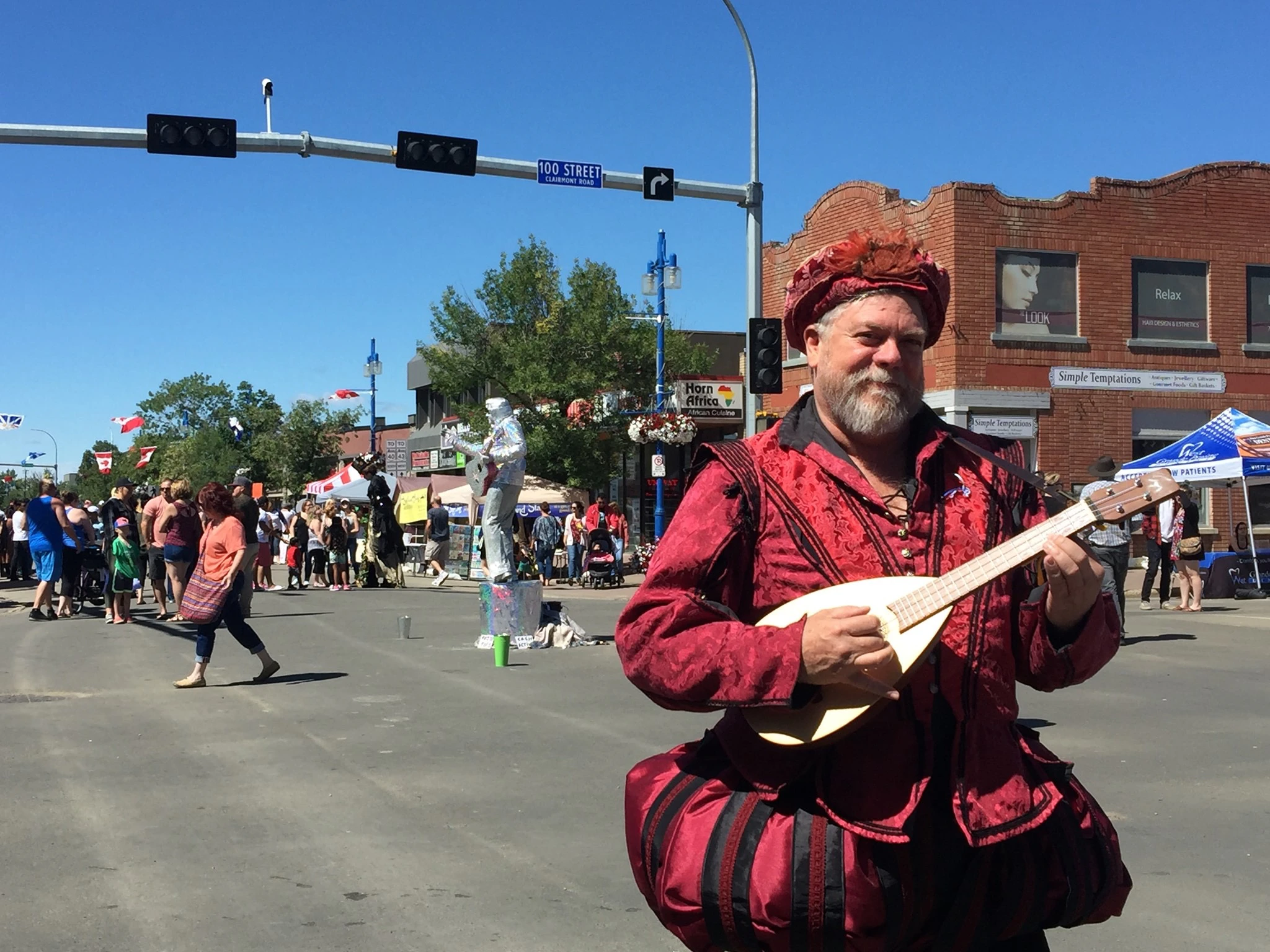
Throughout my twenties, my relationship with my dad ebbed and flowed in terms of closeness and the frequency of seeing each other, despite never living more than a 15-minute drive apart in Toronto. He had various roommates and gigs, a girlfriend here and there, moving in and out. We always kept in touch, and we’ve never been no contact, but the thing about having artist parents is that you have to settle for a level of self-investment that I see is now not present with other “normal” parents. I often worried about his living situation and his ability to take care of himself, although he's always made it work so maybe this was foolish. I knew I wanted him near me in physical proximity. I never liked when he left town or the province for a gig, it made me feel anxious. But, as it does, motherhood buoyed me towards a new priority and so I had to refocus any energy I spent worrying about my dad to my new role as a mother.
My obsession, currently and for the foreseeable future, is with my nearly two-year-old son. I don’t think this was ever the case for my parents. They love me deeply and thoroughly, but they’ve always been highly preoccupied with their own lives, and as I get older, I understand this more than I ever have. You can’t really create if you’re living for someone else. I don’t necessarily carry this burden. If what I’m writing right now never sees the light of day–I won’t fret, my son gets home from daycare in an hour and a half, and that’s the best part of my day, of any day.
My husband and I waited to tell our parents that we were pregnant until I was about 10 weeks along. It had been a long, nauseous first trimester and I felt I couldn’t hide it anymore. We told my mom, Dad, mother-in-law, and her husband right before Christmas. After dinner, my husband asks, “So, do you guys have any plans for next July?” and before they could respond he whipped out the ultrasound, and the table erupted. My Mom cried. My Dad smiled and gave me a hug, but he seemed stunned. I’m honestly still not sure what he thought at that moment, but I didn’t get a sense of him feeling entirely overjoyed. It seemed like it was a lot for him to take in and that maybe there was an underlying sense of fear, of the impending responsibility for him? Maybe, but certainly for us both.
The rest of my pregnancy marked a real distance between my dad and me. We weren’t not talking, but we weren’t talking. I often wondered if he felt a sense of abandonment upon my choice to procreate, as in many ways and for many years, we had an extremely intimate relationship. I wanted him to be there for me more, but he would say and do things that made me feel like he wasn’t. There was a bit of a tussle over getting the TDAP vaccine (he wasn’t reluctant, he just got anxious about booking the appointment with his mean doctor). It felt like he couldn’t relinquish his focus from himself to me, which is what I desperately wanted at the time. I wanted, for these nine months, to feel like the centre of his world. No inward gazing. Just me really being his kid.


As we neared delivery, I was certain that I didn’t want visitors. I didn’t want hospital visitors or postpartum visitors at home. I wanted space and to be alone. I kept telling my husband that I wished I could give birth alone, in a forest, with no one around. I didn’t want to be perceived, and I certainly didn’t want my baby to be perceived. I didn’t want family members to know the intimate details about how dilated I was leading up to labour or when my induction was. I wanted to be left alone. None of this happened–and thank God for that.
After a relatively easy induction and a lightning speed birth (to quote my husband: I “pushed for all of ‘Give a Little Bit’ by Supertramp and half of ‘Someday’ by the Strokes”), we returned home. All seemed well. It was a Saturday. I had a nap while my husband took the baby. As I awoke from the nap, I experienced what I can only assume is what psychosis feels like. I was in an Alice in Wonderland-style version of my apartment. Everything was not as it should have been, like I was seeing through a fun-mirror kaleidoscope. My cat’s fur was too soft, the walls didn’t look right, I was scared of the baby, I needed to go back to the hospital. I did not go back to the hospital. But everyone came to me. Friends slept over and drove in from cities hours away to be with us. I sobbed and sobbed, maybe more than I had ever sobbed in my whole life.
On day three or four, my dad, who lived about a 10-minute electric scooter ride away from us at the time, showed up. And he kept showing up when everyone else had to return to their jobs, lives, and their own crises. He slept on our couch for weeks. He learned to disassemble, clean, sterilize and reassemble my breast pump parts. He held the baby and got him to sleep. He didn’t say anything stupid to me about how I was feeling. He cuddled me. He asked me what I needed. He never once made it seem like he had somewhere else to be, even though I know he probably did.
As it tends to do, time moved in a forward direction, weeks turned into months, my Zoloft began working so well I didn’t require the same constant accompaniment I once did, but my dad didn’t really go home. He was there for dinners and holidays. Whenever I needed a hand or whenever he needed a ride (his licence, my car), he was there. He and my son developed an incomprehensibly close bond. Peas in a pod. And when we were looking for a new rental last June to accommodate our growing family, and we learned that the house we were interested in had an unoccupied basement apartment, we frantically called him. We made spreadsheets, negotiated, and moved our budget around so he could maintain the same rent he had been paying for his basement apartment a few streets over. He agreed, but he kept saying I don’t want to be a burden.


"I don’t know why my dad showed up so well after my son was born. Maybe he needed the baby to be here, earthside, to see how much I needed him."
That was a year ago, and we’ve had our ups and downs. Living with a parent in adulthood is not for the faint of heart. There’s a lot of giving and taking on both sides. Every day, our son lists off the members of our household: Mama, Dada, OPA!, Nala (cat), Kramer (also cat). He begs to go downstairs to see Opa, where his extremely chaotic living room has been turned into a jingbang masterpiece of toddler curiosities: a Cuban cigar box full of restaurant-acquired crayons, a book of classic Jazz greats and its accompanying playing cards and a toy shark that has butterfly wings inexplicably zip-tied onto it (he adds upon reading this that it is meant to be the holy mackerel). Opa will not stop buying my son the 2-dollar cars at the grocery store. Opa always says, “Can I tell you something?” to our son, which has led him to say, “Opa, Opa, tell me, tell me!” whenever he sees him.
Now, I find myself driving Opa around—to Costco or daycare pickup, for coffee, Home Depot or other errands. I always buy him a coffee that he will not finish. I play Big Thief in the car, and he turns it up: “Who is this again?” And I find myself feeling like I am able to provide him with the luxury of those coming and going moments of stability he provided me in interludes as a child. I get to give him a safety—a home, an ability to go where he needs to go and get what he needs to get done. He doesn’t have to beg or wonder. The instability fades because he knows he’s here, at home, with us. What do I get? Someone to watch my kid while I make dinner or take him to school when we’re sick or just be with us. I get my dad.
I don’t know why my dad showed up so well after I gave birth. Maybe he needed the baby to be here, earthside, to see how much I needed him. Maybe it was the postpartum depression, and it scared him. Or maybe he just didn’t know how to centre me before I had my son because I was always so good at doing things on my own. But a switch flipped when my son got here. I don’t know what the next 10 or 20 years look like, but as we look towards having a second kid, I don’t know how we would possibly do it without Opa downstairs.
I frequently overhear him telling my son he loves him, with one caveat: “I love you so much, the most in the world, after your mother.”
Ruby Dallas is a mother, Formula One obsessive, and a self-described policy wonk. This is her first foray out of the closeted-writer phase, and she's currently working on a series of essays about motherhood, postpartum depression, and the idea of the village. When she's brave enough to start posting, you can find her Substack here.