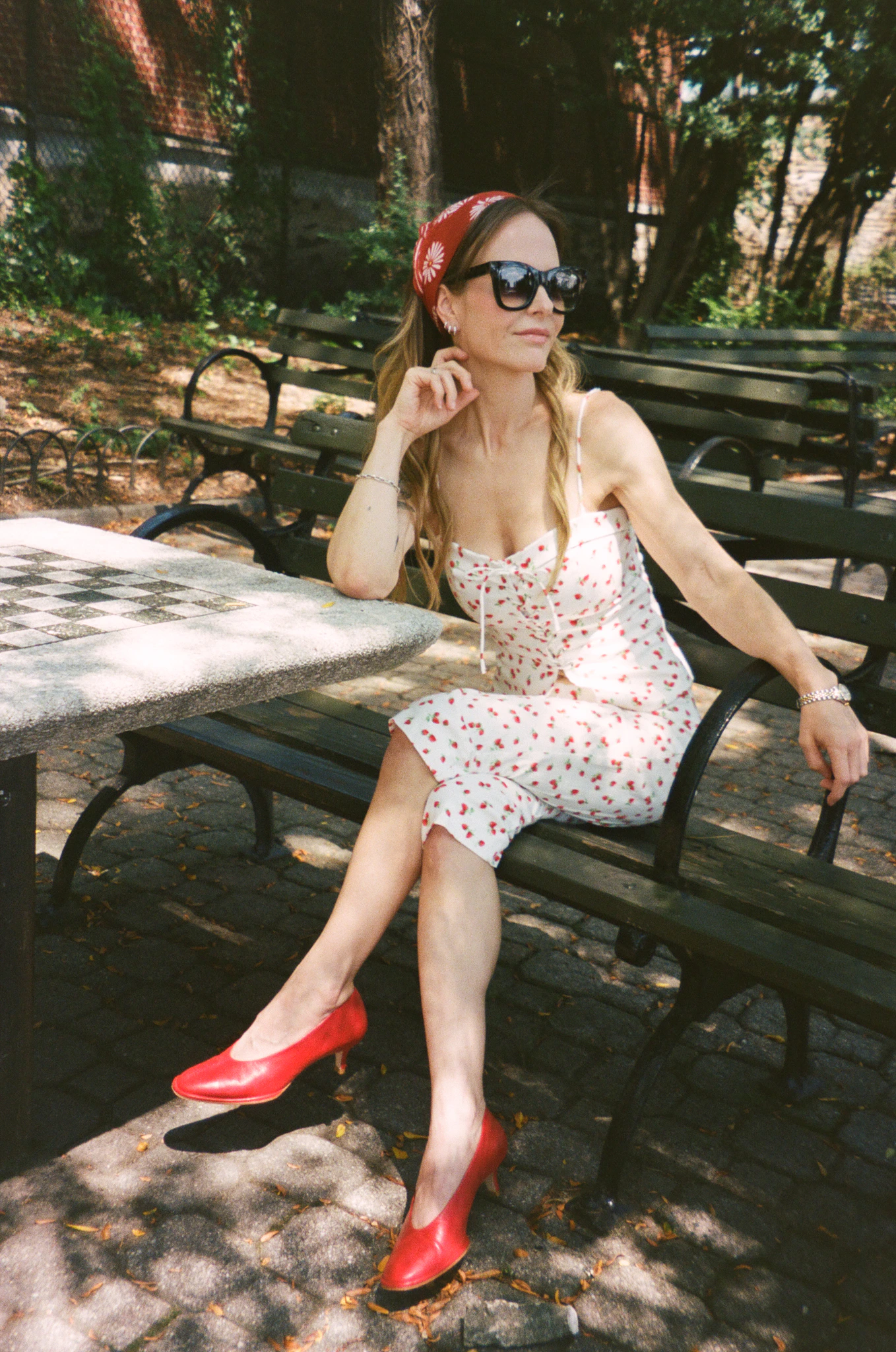
Getting Sticky with Rosebud Baker
For her Netflix comedy special Mother Lode, comedian Rosebud Baker made the creative decision to switch back and forth between footage of her performing at eight-months pregnant and at 11 months postpartum. The result is astounding, and the jokes will have you nodding in recognition and testing the strength of your own pelvic floor.
It’s her dry delivery, her radical honesty, and gift of observation that makes her one the funniest stand-ups on the scene. Prior to blowing up as a solo act, she cut her teeth as a writer at Saturday Night Live, an experience that prepared her for the late nights early motherhood demands.
Below with the utmost humor and profundity, she spoke to us about IVF (“the most money I ever spent on drugs and none of them got me high,” she jokes in her special); touring while pregnant; and experiencing the world through a child’s imagination—hint: it helps to have a background in improv.
Words by Emily Barasch; Images by Janna Tew
"Once I became a mother and was holding my baby, I had this sudden, terrifying realization: Oh my God, I've never respected mothers. I don't have respect for mothers."

“Nobody notices mothers”
I honestly didn't know if I wanted to be a mother until I was one. I knew that I was curious about being a mother, and that curiosity was bothersome in a way. I knew that I would feel regret if I didn't do something. I've only ever felt regret about not doing something.
It's the scariest thing because it's truly an irreversible decision. I really felt afraid but I just did it anyway. But it wasn't like, "I don't want to be a mom." It was more like, "I'm really scared of what being a mom means, and I'm going to do it anyway." I really liked my life the way it was, but will I like it the way it becomes?
In the States, you almost don't notice how we treat mothers because nobody notices mothers. It's so dismissive. Once I became a mother, I had this sudden, terrifying realization: Oh my God, I've never respected mothers. I don't have respect for mothers. I did not realize that until I was holding my own baby.
I had a lot of fear around postpartum and what that would mean. And I had a lot of fear around—I couldn't name it before—but it was this fear of, "Am I going to be supported? Am I going to feel like this is all going to end up in my lap?"
Working at SNL = motherhood prep boot camp?
I think, out of anything that I’ve done, SNL was the best preparation for motherhood because you literally have to put your own stuff aside and get to work. You have to be in a good place to do that work.
It's this delicate balance between putting your own feelings aside and also regulating your emotions before jumping into something, because you have to show up as your best self. And I was working non-stop while completely sleep-deprived. I mean, I was too tired to even form new memories. So it was probably the absolute best thing that I could do to prepare myself for motherhood.
Losing the pink cloud of pregnancy after loss
I had had two miscarriages and decided to do IVF—to freeze embryos and do an embryo transfer when I was ready—because I felt like, after the two miscarriages, I was like, "I can't do this again. I need some sort of assurance that if I get pregnant again, the embryo is healthy because I can't go through another loss.” So IVF allowed me to get healthy embryos.
But then, two months after we got those embryos, my husband and I got pregnant naturally. It was scary. When you've been through multiple losses, you never really get that first-pregnancy feeling ever again. You never get that feeling of just pure hope and this sort of clean-slate future that you imagine for yourself the first time you get pregnant. That only happens once.
If you have a loss—or even if you carry that pregnancy to term—the second pregnancy is different because now you know what it really is. So you don't have that sort of pie-in-the-sky, rose-colored-glasses thing.
I felt really anxious for a lot of it. My life has had a lot of loss in it, and certainly that has influenced the way that I walk into situations where I should be feeling really hopeful. Instead, I sort of hold onto any excitement and go, "Let's not get excited. Let's just hold on. Let's just see how this goes."
I don't think I felt really comfortable until I'd reached about 20 weeks. And even then, I had this horrible fear of what could happen, because I'd read about what could happen. And, you know, nobody thinks it's going to happen to them until it happens to them. I was really scared.
The agony and ecstasy of touring while pregnant
Being pregnant while touring is exhausting. Exhausting. I had SPD [symphysis pubis dysfunction] so I really couldn't stand for very long., I was touring alone. I had my bags, and I was getting in and out of cars, getting in and out of plane seats. That was all incredibly painful.
I used to sit on two soda cans just to ice my pelvis in the green room, and then I'd get up, waddle on stage, and just sit on a stool at the very end because I was like: "I literally can't stand up."
It was difficult, but at the same time, there were parts of it that I really loved. Usually touring is a really dismal experience. You know, you go on stage and then you go back to your hotel room, and you go from this experience of being surrounded by people who are laughing and who are loving what you do, ideally, and then you go back to this empty hotel room to an episode of Law & Order.
Being pregnant was different. I felt like every time I went back to my hotel room, I was like, "It's me and her. We're together." I just had this little buddy with me that I never felt like I was alone on the road. I would go back and just rub my belly, and she was a mover. It was like she was just like, "Yeah, I'm here. I'm here."
Why Rosebud choose a C-section
I opted for a C-section, mainly because of the SPD and the size of my baby. My husband is 6'2", I'm 5'3", and my daughter is now two years old and she's 3'5". So she was a big baby and tall, and I just thought, I don't know. There's a part of me that feels safest doing a C-section. I did that, and it was great. I loved it. I felt like it was really relaxing.
It's amazing. I run a tight ship, so I was like, "Let's get in at 8 and let's get out at 9:30 and have a baby." I just compared giving birth to choosing a style of car crash that you wanted to have. If somebody gave me a menu of different ways to get in a car crash, I thought: I don't know. I guess I'll take the fastest one.
Pregnancy and birth were crazy and metaphysical, but they weren't this spiritual thing for me. I was terrified the whole way. I was really scared, and I wasn't really able to go with the flow. I thought: My body can make a baby do crazy things. I've seen enough. Let's have a C-section.

"I went back to work after six weeks. It was like going to space and coming home and everyone being like, 'You know, who gives a shit? You went to space.' Compared to the magnitude of the experience itself, nobody could possibly meet me where I was at."
Birth and postpartum are like “wrestling an angel”
The moment my daughter got here, I remember hearing her cry, and I remember being able to know exactly where she was in the room. I remember thinking: This is so weird. I have sonar or something. I know exactly where she is.
Even when she wasn't crying, I just knew where she was. And obviously that big sheet was up, so I couldn't really see, but I just knew.
The nurse brought her over to me, and in the middle of her crying, I said, "I know." I just was like, "I know." And she heard my voice and she stopped crying because she recognized it.
I'm not a very religious person, but I was like: Oh, God is real. In that moment, I felt like God was real. Holding her, that feeling of love and how terrifying it was—it all felt very spiritual to me.
People talk about spiritual experiences like they're these beautiful, white-light moments, but really they're like wrestling an angel. That's what giving birth and holding your child and experiencing postpartum felt like. You're terrified and it's beautiful, and it's all happening at the same time.
Recaliberating…everything?
I was so sure about who I was. And then she came along and everything changed so suddenly that it has taken me a really long time to sort of figure out: Who am I now? What do I find funny now?
I definitely thought for a while that I was never going to be funny again. But I went back to work so quickly and was put in situations where I literally had to pitch jokes, and I was like: Well, I know it's still there. I just—it’s just hard to reach because everything feels so serious.
When the mat leave is minimal:
I went back to work after six weeks. It was like going to space and coming home and everyone being like, "You know, who gives a shit? You went to space." Compared to the magnitude of the experience itself, nobody could possibly meet me where I was at.
When I say that, it's not an indictment on them. It's just such a massively different world that I'm coming home to and that I'm coming to work from. I felt extremely isolated and I felt really alone. I felt alone even in my marriage.
I felt completely like I didn't understand the people that I'd known for years, and they no longer understood me. And I couldn't quite put my finger on what had changed.I mean, obviously I'd had a baby, but I couldn't figure it out.
I didn't have mom groups, and I didn't have time to do that. There's a lot of comedians that I know who have had kids now, and speaking to fellow mom comics like Michelle Wolf, Rachel Feinstein, and Esther Povitsky, has been really helpful.
Because there is this specific thing of you spending your entire life making comedy and it’s the number one thing that you care about and then you make it your entire identity and then lose that so quickly. It's a little traumatic. Because it's not like a nine-to-five. You're taking your kids on the road with you. The mental load is constantly shifting and changing and so having mothers in my corner who have that exact experience has been insanely helpful.
Day-to-day, ins and outs
My daughters in school or daycare from nine a.m. until six p.m. I pick her up early whenever I have a day that doesn't involve any sort of interviews, podcasts, whatever just to spend time with her.
My sister lives in New York. Sometimes she steps in. I had a nanny who I loved but ended up having to let go of because the cost was astronomical. It's really not much of a support system. But it's what I have and we seem to be doing okay. Thank God I have one child.
I love being with her, and I have enough flexibility in my life and in my schedule that I can do that and not feel completely crushed by the weight of that. A lot of times I feel energized by it. I'm kind of really impressed with what I've been able to get done and what I've been able to continue to do while being a single mom.
Their childhood = our muse
The best part about being my daughter’s mom is the ways in which she's allowed me to experience the world through a child's imagination. You know how she'll see anything shaped—if she sees the shape of a circle with a cone underneath it, whatever it is, it's ice cream.
She had her first nightmare. I walked into her room and she was crying, and she said, "There's carrots coming out of the walls." And I was like, "Jesus, that's actually really scary." You know, if you think about it, like the pointy parts of carrots just popping out through the walls? Terrifying.
And I have a lot of experience dealing with friends who are tripping—tripping on acid or tripping on mushrooms. And I immediately thought: Oh, this is just the same as that. You don't deny what they're seeing. You have to go along with what they're seeing. So I was like, "Oh my God, there's—you're right. There's carrots everywhere."
I took any improv training that I had and I was like, "We gotta get you out of here." I started pretending to eat the carrots out of the walls and having her point to which ones were the scariest. I would eat these carrots and then she still didn't want to go in there. And I was like, "Well, now that I've eaten all of them, I guess I have to poop them out so that they never come back." And she was like, "Yes, thank you."
It was like having this kind of comedic instinct to just meet her wherever she was at makes being a parent so much more fun. She has such a vivid, wild imagination and she's hyperverbal. So we just make each other laugh all day.
As a mother, I'm so proud of her. But as a creative person, too, I'm think: What an incredible tool to use in my own life—a tool of observation, to just be constantly asked questions about things that I take for granted every day.
Nothing else like it
I had an incredible gratitude for my daughter, but for the work of motherhood, I can't say that I always felt grateful for it. But more recently, spending so much time with her, I have seen so much growth. You just start to realize that the more you give to someone, the more you sacrifice for someone, the more love you feel for them.
It's not even about the love that you get back. But the more I sacrifice, the more I give to my child, the more I love her and the more grateful I am. I don't know any other relationship in my life that works that way.
Honestly, if there were every other relationship in my life where the more I sacrificed for nothing in return—not to imply that I'm getting nothing in return, but every other relationship that has worked that way has just drained me. But it's almost like with her, the more drained I am at the end of the day, the more I love her. It's so different from any love that I ever felt.